Sheet materials
Plywood, MDF or OSB: choose by application
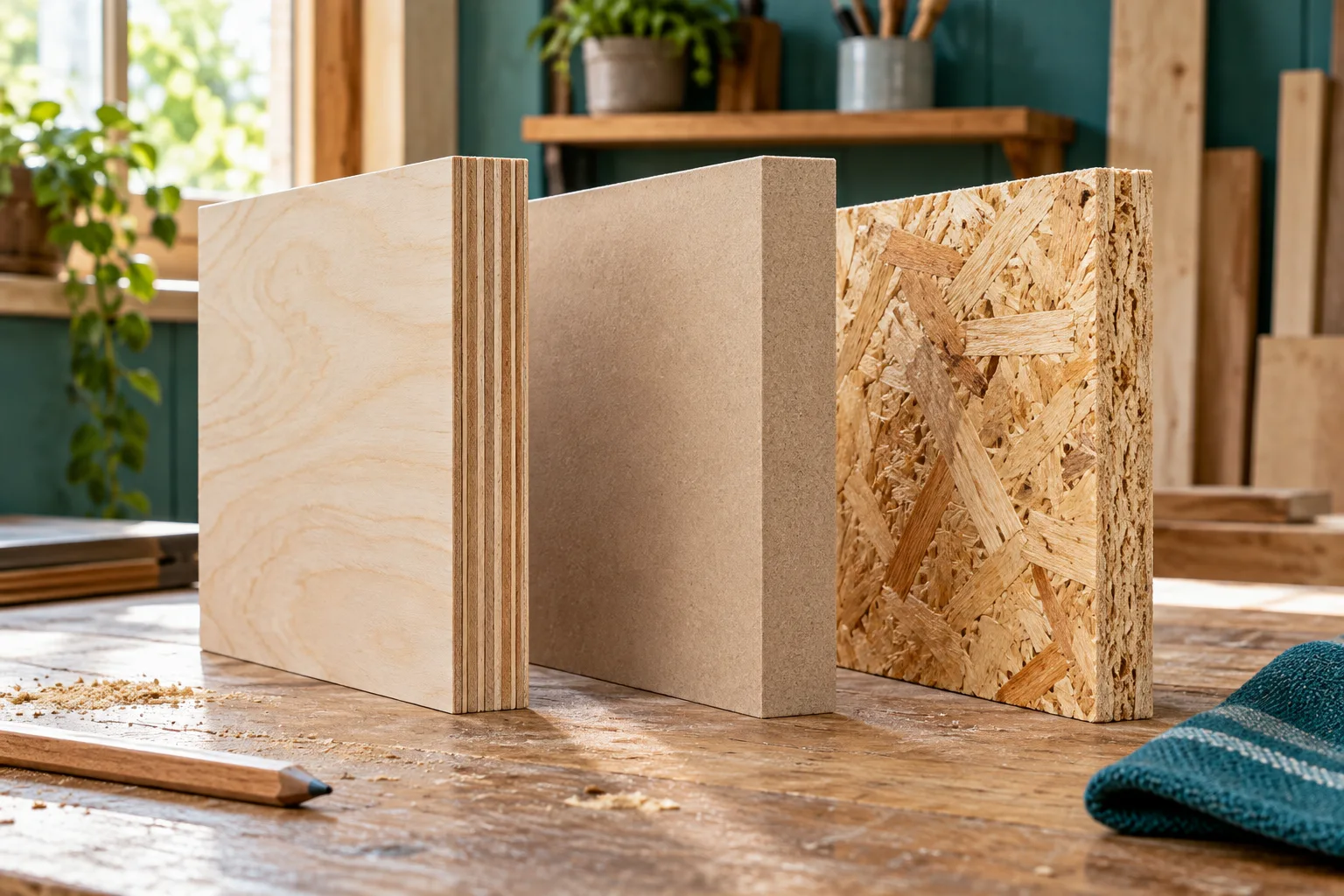
Panel choice should begin with exposure, finish and fixing requirements. Plywood has layered veneers, MDF a fine fibre structure, and OSB oriented strands.
Understand the requirement
Panel choice should begin with exposure, finish and fixing requirements. Plywood has layered veneers, MDF a fine fibre structure, and OSB oriented strands. Their appearance does not establish structural suitability. Read the declared grade, thickness and intended use; two boards bearing the same material name may have different performance.
Choose the right calculation
For a painted indoor cabinet, edge finish and screw holding can matter more than the cheapest square-metre price. For sheathing, use a product specified for that assembly. Moisture-resistant does not automatically mean permanent outdoor suitability. Compare delivered costs only after you have identified panels that meet the actual requirements.
Check the product and the order
Check sheet orientation and surface grade before accepting a rotated part. A cutting plan is a geometric proposal; it cannot inspect a veneer face or verify a structural rating. Keep edge protection and finishing in the purchasing list where the selected application needs them. Save full dimensions for reusable remnants so future parts can be tested for fit.
Worked example
A transparent planning example
Use these inputs to follow the calculation. The result below explains what can and cannot be concluded from it.
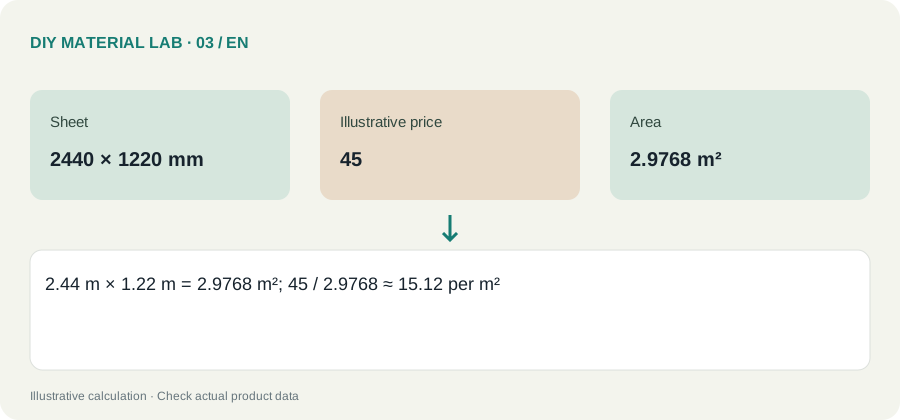
| Sheet | 2440 × 1220 mm |
|---|---|
| Illustrative price | 45 |
| Area | 2.9768 m² |
A second sheet costing 38 but covering only 2.5 m² costs 15.20 per m². It is not cheaper per usable area. Add edging, finishing and transport before choosing; these example prices are not market quotations.
Compare the scenarios
The following comparison isolates the quantities or assumptions discussed in the example. It is a planning illustration, not measured performance data.
Values are calculated from the illustrative inputs above. Different products or dimensions change the result.
Planning checklist
- Measure the actual project and record the units next to every dimension. Identify the regions or parts counted so nothing is included twice.
- Confirm the exact material format and its product instructions. Replace the example inputs with declared dimensions, coverage or yield from your chosen product.
- Calculate the net requirement first. Show cutting or application allowance separately and check whether the example method fits your geometry.
- Convert to whole supplier units once, then price the complete order including compatible accessories, delivery and any separately specified repair stock.
Mistakes to avoid
Do not mix millimetres and metres in the same multiplication. Do not apply a reserve twice, and do not treat a rounded purchase unit as proof that every part fits. Recheck the specific limitation described in the worked example before paying for the order.
Questions and answers
Can I copy the example quantities directly?
No. The examples demonstrate the calculation, not your exact room, layout or product. Replace the inputs and check the specific limitation explained with the result.
What should I verify before ordering?
A second sheet costing 38 but covering only 2.5 m² costs 15.20 per m². It is not cheaper per usable area. Add edging, finishing and transport before choosing; these example prices are not market quotations.